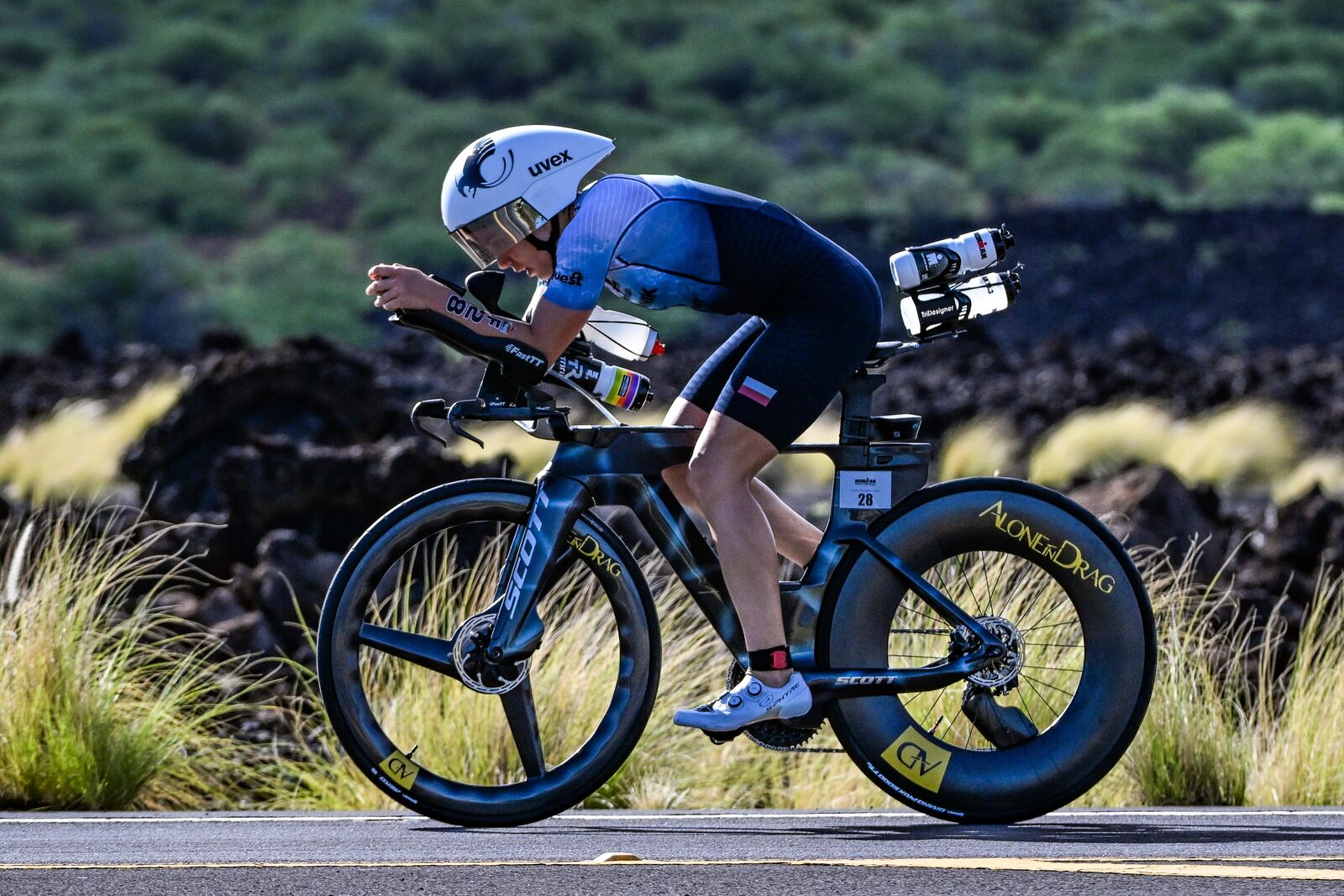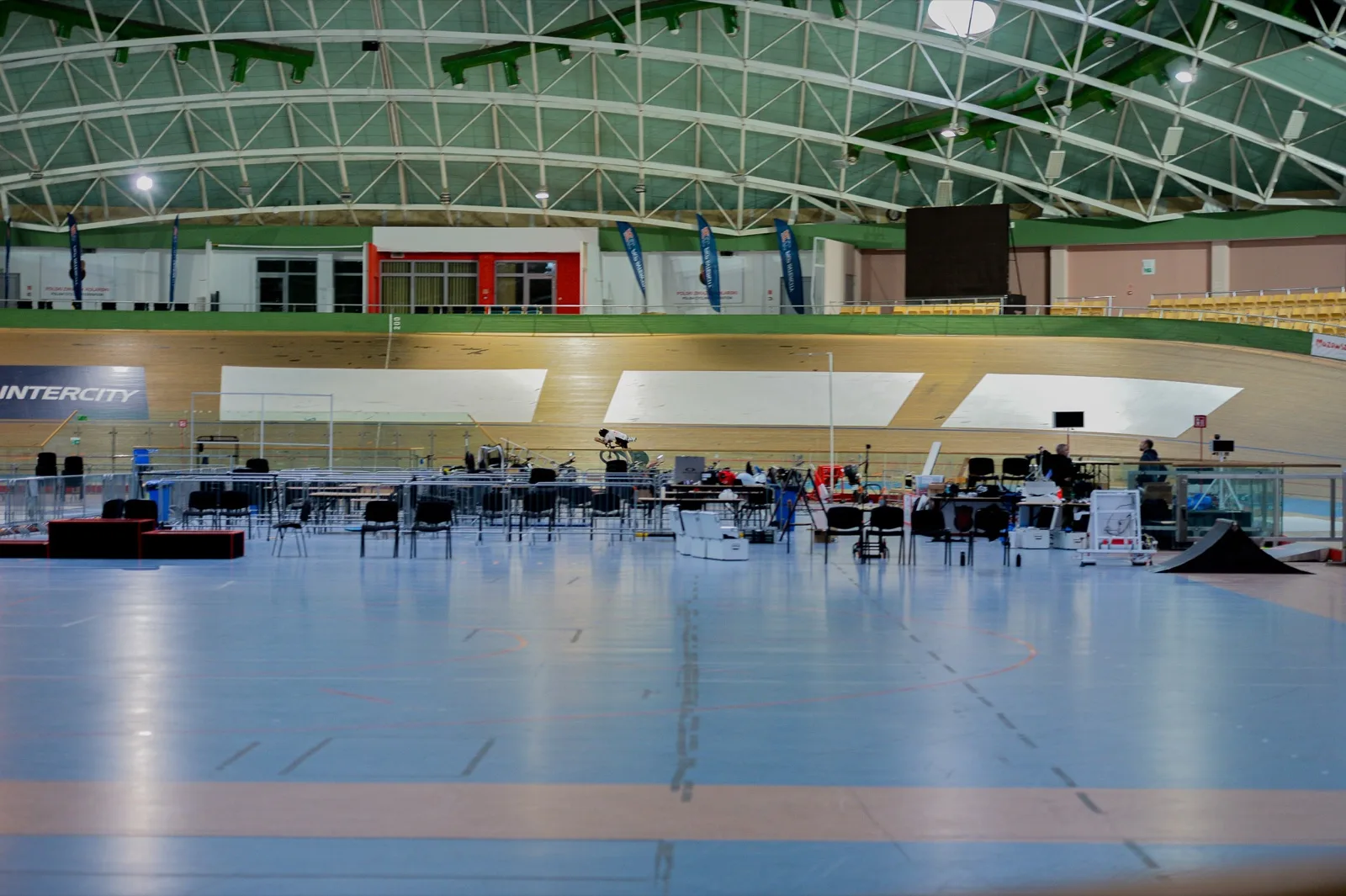
Most people know Władimir from a track covered in ice, but the Olympic medallist (more on that here) often gets on a bike during his summer build-up to target races. In the post-Olympic season, Semirunnij decided to try his hand at a cycling discipline that has a lot in common with long-track speed skating, the time trial, which meant we could help him with equipment choice and set-up. Working with the Polish Speed Skating Federation (PZŁS) before the Olympics, we felt we were “playing away”: we understood the physics of skating, but some of the less obvious details we had to ask about and clear up as we went. In the time trial, we were very much playing at home. At a velodrome session, after an initial position set-up, we ran a test that showed a nine per cent drop in the rider’s CdA. At the speeds Władimir rides, that’s a 35–40 W difference, which works out at more than 2 s/km saved.
Olympians don’t do anything by halves: in for a penny, in for a national title. Together with his national skating teammate Eryk Marciniak, Władimir lined up at the Polish two-up time trial championships. Two skaters winning a cycling championship left the cycling world mildly embarrassed, but this post isn’t about the feelings and reflections of the beaten cyclists. It’s a closer look at how two skaters “playing away” rode their race.
Let’s start with the two riders’ size. Władimir is taller (by 10 cm) and heavier (by 6 kg), so you’d expect two things: 1. Eryk’s CdA will be lower; 2. Eryk can tuck in better behind Władimir and rest more on his wheel. Sure enough, when Eryk sat on the wheel his CdA dropped by 31% (against a 22% drop for Władimir), but Eryk’s CdA itself was slightly higher (0.213 m² against Władimir’s 0.210 m²). Should the smaller rider’s higher CdA come as a surprise? From a physics point of view, probably yes, but remember that only one of them came to see us at the Pruszków velodrome ;).
The work on the front was split 60–40, with Władimir taking the bigger share. The table below shows why Eryk’s turns were fewer (17 vs. 19) and shorter (46 s vs. 63 s) than the Olympic medallist’s.
| Metric | Władimir | Eryk |
|---|---|---|
| W/kg, average | 5.40 | 5.42 |
| W/kg, NP | 5.49 | 5.57 |
| W/kg on the front | 5.76 | 6.24 |
| W/CdA on the front | 2141 W/m² | 2108 W/m² |
| W/CdA, whole race | 2141 W/m² | 2096 W/m² |
Table 1. Władimir and Eryk at the Polish two-up time trial championships.
Eryk’s average W/kg on the front was clearly higher. A smaller rider with a similar CdA had to produce the same power on a flat time trial to hold the pair’s pace. Physiologically, that cost him more: almost 0.5 W/kg on each turn. Shorter, harder turns and a more effective “rest” on Władimir’s back (a 31% drop in CdA) meant both of them worked equally hard (see W/kg for the whole race). But the higher W/CdA and average power (not accounting for weight) on a flat course show that Władimir was the duo’s engine.
Did one rider’s aero fitting win the pair the gold? That would certainly make a lovely ending to this post, but we still believe it’s better to win by 56 s than by 23 s…
Planning to race as a pair or a team, or know someone who wants to optimise their position? Good timing: we run pair sessions at the Pruszków velodrome, and you can sign up here. No teammates, or would rather they didn’t get faster along with you? No problem: use the same form to book a solo session at the velodrome or in the wind tunnel.