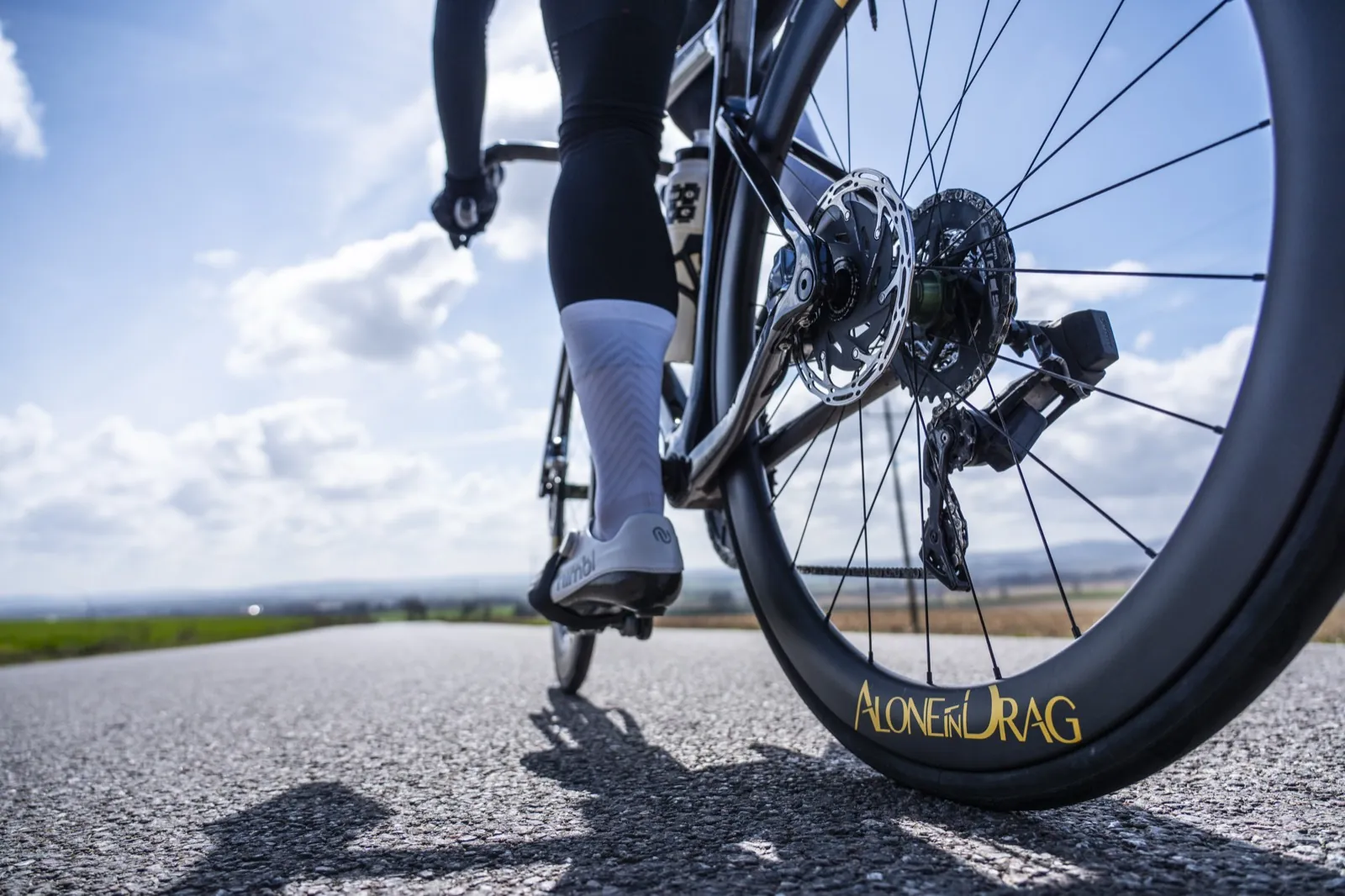
The first in a series on how we choose equipment at Alone in Drag, by data, not by feel.
Before we ever got to rim depth, we did the step that comes first: we tunnel-tested dozens of rim profiles and identified the fastest aerodynamic shapes. Only with that foundation settled could we ask the right question, the one we answer here: with the shape already chosen, how many millimetres: 60 or 50, front and rear?
In the coming pieces in this series we’ll show how we arrived at the rim shape itself, how we weighed mass against aerodynamics, and how our design differs from other constructions. Here, we focus on one concrete decision.
Through centuries of evolution as humans we are programmed to look for symmetry. Symmetrical faces are subconsciously associated with health and strong genes; regular structures such as honeycombs are perceived as strong and reliable. However, this is not a story of perception and beliefs but one of engineering and data-driven decision making.
SaBRe VI.V was always meant to be a true allrounder among wheelsets. Something durable to train on and fast across the range of flat, twisty and rolling terrain typical of triathlon and road racing. Durability and servicing ease are handled by proven Pillar Wing 20 spokes with easy access and external nipples, and Soul-Kozak hubs with the patented M-netic ratchet system. What about race performance, you ask? Let us start with the building blocks of wheel performance and a short description of how they influence the ride.

| Quantity | What it describes |
|---|---|
| Mass (kg) | physical quantity affecting gravitational pull |
| Moment of inertia (kg·m²) | measure of an object’s resistance to changes in rotational motion |
| CdA (m²) | product of aerodynamic drag coefficient and frontal area, affecting the aerodynamic forces acting on a body |
Table 1. Building blocks of wheel performance.
Through our extensive testing of rim depth and profiles (more on that in a separate post), we identified the 50–60mm rim depth as the aerodynamic sweet spot for allround wheels. That left us with four possible configurations for front and rear rim depths: 50/50, 60/60, 60/50 and 50/60. How to decide which one will perform best? Another good question, and I am glad you asked. We can use the wheel performance building blocks above to inform our decision.
Mass
The obvious starting point is the rim weight difference between a 50mm and a 60mm, which in our case stands at 50g per rim. Another small difference stems from the use of shorter (hence lighter) spokes for the 60mm rims, equating to a 2g saving per wheel. That brings us to the four options:
| Rim depths front/rear (mm) | Mass difference (g) |
|---|---|
| 50/50 | — |
| 60/50 | +48 |
| 50/60 | +48 |
| 60/60 | +96 |
Table 2. Mass difference for wheelset options.

Moment of inertia
The further the mass from its axis of rotation, the greater its resistance to changes in rotational velocity, or in plain English: the more mass you place away from the hub, the harder it is to accelerate out of the corners. This is the second performance building block that favours the shallower rim section.
| Rim depths front/rear (mm) | Moment of inertia difference (kg·m²) |
|---|---|
| 50/50 | — |
| 60/50 | 0.0045 |
| 50/60 | 0.0045 |
| 60/60 | 0.0090 |
Table 3. Moment of inertia difference for wheelset options.

CdA
If you are still reading this, there is a good chance you are familiar with CdA, the measure of how slippery an object is in given wind conditions. Depending on the wind speed and the direction it hits you (the relative wind angle, or yaw), objects such as wheels behave differently. The lower the CdA, the less power you need to maintain a given speed, or the greater the speed at a fixed power level. Looking at the wind-tunnel data below (Figure 1), two things are clear: 50/50 is the slowest option, and for the mixed sets the configuration of front and rear depth does matter.

Figure 1. CdA versus yaw for four rim-depth configurations at 40 and 45 km/h.
From data to race performance
How to translate all of those measured differences into race performance gains? No better way than taking a real-life race dataset and simulating the outcome for four wheel-choice scenarios.
For the test we reached for a real race file, a fast, flat road race covering 39.7 km of active riding in just under 55 minutes, held at an average of 43 km/h for 325 W (358 W normalised). It is exactly the sort of day the SaBRe VI.V is built for.

Rather than guess, we ran the whole ride through a model solving the cycling equation of motion, second by second. Taking the rider’s real speed and direction, we reconstructed the apparent wind and its yaw angle at every moment, read the matching CdA straight off the wind-tunnel curves, then simply swapped the wheels underneath them, with power and weather held fixed.
With the 50/50 as our baseline, here is what each set actually banked over the full race:
| Rim depths front/rear (mm) | Energy saved (kJ) | Aero power saving (W) | Equivalent freewheeling time (s) |
|---|---|---|---|
| 50/50 | — | — | — |
| 60/50 | 10.5 | 3.2 | 32 |
| 50/60 | 2.1 | 0.6 | 6 |
| 60/60 | 9.2 | 2.8 | 28 |
Table 4. Race performance gain versus 50/50.
The numbers tell a tidy story. The 60/50 is the standout, saving 10.5 kJ of work across the race. It is worth a steady 3.2 W or, put more tangibly, the equivalent of freewheeling for 32 seconds while everyone around you keeps pedalling. What may surprise you is that it beats even the full-depth 60/60: with the wind crossing the bike for most of the race, the shallower 50mm rear does not add aerodynamic drag at those yaw angles, while a deeper rear only adds mass. So even after conceding a few grams and a lower moment of inertia to the 50/50 (both of which we accounted for above), the 60/50 quietly turns the day’s crosswinds into free speed.

But what about the climbs?
A road race is rarely all flat. Surely on a climb the lighter 50/50 must win? It is a fair question, and the honest answer is “it depends”.
The deep front’s aerodynamic advantage fades as you slow down. Drag scales with the cube of speed, so on a steep ramp at low speeds the influence of aerodynamics is negligible, while every gram you are hauling up the slope is felt in full. The cross-over gradient, plotted against the W/kg generated by a rider, marks the point at which choosing between a lighter or a more aerodynamic wheelset stops making a difference. In Figure 2 you can see the gradients ridden at a given W/kg where each wheelset choice would be optimal.

Figure 2. The fastest wheelset by rider output and gradient, in still air.
The 60/50 takes the rolling middle ground, where most racing actually happens; the full 60/60 holds an edge only on the dead-flat, and the 50/50 surfaces only on steep, sustained climbs. For a wheel that has to do it all, owning the middle is exactly where you want it to be.
The wind moves the threshold
And that crossover is not fixed. It moves with the wind.


Figure 3. The gradient at which 50/50 overtakes 60/50, by apparent-wind yaw angle.
In dead-still air our rider would need a sustained climb of around 4% before the lighter set paid off. Add even a gentle crosswind and that threshold moves past 6, 7, even 8%, because the very wind that gave the advantage to the 60/50 on the flat keeps it ahead on the uphill.
Which brings us neatly back to the start. Across the flats, the rollers and all but the steepest still-air climbs, the data keeps landing on the same answer, and it is not the symmetrical one. Don’t go 50/50 if 60/50 is on the table.
